Note: This article reflects my personal opinion. It is in no way a recommendation or endorsement of any company or solution.
For the past few years, the AI landscape has been nothing short of chaotic.
New models have appeared almost weekly. Market leaders have changed overnight. Frameworks, startups, “AI experts” and new tooling have flooded the market at a pace few organisations have been able to keep up with.
For developers and others who work in code, the method of use has been settled for some time. AI is already an integral part of many software development workflows, coding, testing, documentation, troubleshooting, review.
But one question keeps coming back:
When will enterprises actually realise the productivity gains outside software development?
This post is my answer to that question.
Many office workers now have access to AI and use it in their daily work, but that use is mostly limited to chatbots: analysing text and generating text back. This has increased efficiency somewhat, but the promise of AI is not fully there. Reports get written a bit faster. Slide decks get assembled a bit quicker. And we may simply be producing more text, more slides, more content.
The numbers back this up. A 2026 NBER working paper surveying nearly 6,000 executives across the US, UK, Germany and Australia found that around 70% of firms actively use AI. Yet more than 80% reported no impact on either employment or productivity over the previous three years. (NBER Working Paper 34836).
We were promised digital colleagues who could carry work forward alongside employees, not assistants waiting for the next prompt.
The issue
For many business use cases, the limiting factor is no longer model capability. Modern models can already summarise documents, extract information, classify content, reason across sources and use tools to complete complex tasks.
So why the hold-up?
Enterprises were never asking whether an LLM could summarise a document.
They were asking questions like:
- Where does the agent run?
- Which identity does it use?
- What systems and data can it access?
- How do we audit its actions?
- How do we revoke its access?
- How do we keep sensitive data inside our security boundary?
- How do we defend against malicious instructions hidden in the data it processes?
- Who is accountable when the agent makes a mistake?
None of these questions were impossible to answer. The problem was that every answer had to be designed, integrated and operated separately. You could build an impressive agent, but productionising it meant stitching together model endpoints, agent frameworks, vector databases, identity mechanisms, gateways, logging and security controls by hand.
The biggest obstacle was never the intelligence of the models. It was the lack of an enterprise operating model around them.
The solution
The major hyperscalers have increasingly converged on a similar answer: managed enterprise agent platforms. The providers use different terminology, but collectively these platforms act as something resembling an AI harness, a managed environment around the agent that provides the runtime, identity, connectivity, controls and observability required for production use.
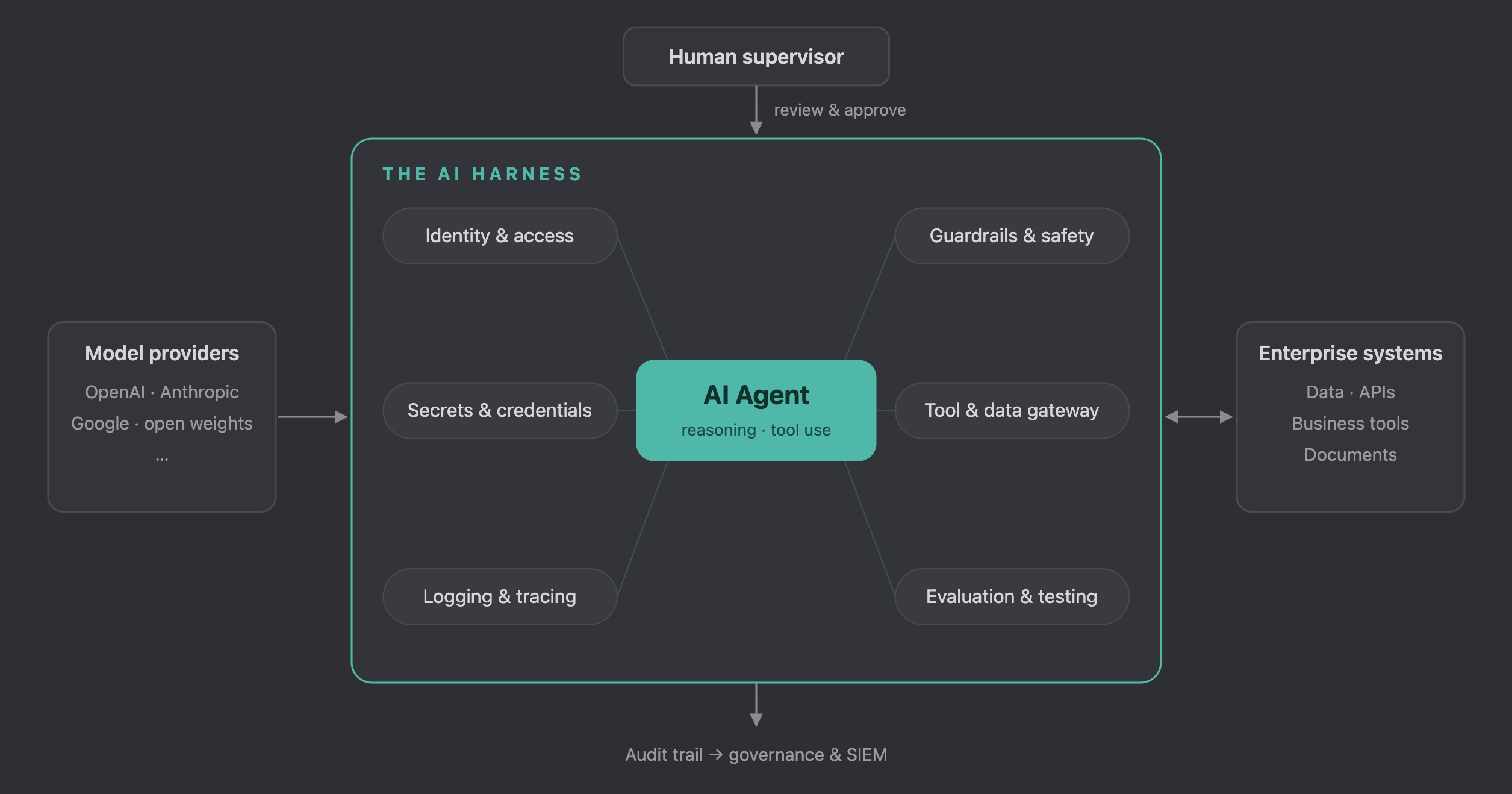
The names differ, but they are all enterprise AI platforms:
- Amazon Bedrock
- Microsoft Foundry
- Gemini Enterprise Agent Platform
So what is an enterprise AI platform?
Simply put, it is the answer to the questions above. It lets organisations set up agents, workflows and tools with control over identity, access, logging, security gateways, guardrails, evaluation and lifecycle management, all while providing access to the models you need from your favourite providers, OpenAI, Anthropic and others.
These platforms do not make an agent secure or compliant by default. They do something more practical: they give enterprises a place to apply the controls they already understand. An organisation that has invested heavily in a hyperscaler can build AI using the same identity providers, network segmentation, monitoring, policy engines, logging pipelines and governance processes it already operates today — instead of introducing an entirely new security model for AI.
We have seen this before
The public cloud followed the same pattern. Virtual machines existed long before most large organisations were comfortable moving critical workloads to them. The technology alone was not enough. Enterprises needed landing zones, identity patterns, network architectures, policy enforcement and architecture frameworks. Adoption accelerated only when those patterns became established and organisations no longer had to invent the architecture for every new workload.
AI is now entering the same phase. AI is becoming architectable.
What this unlocks
Enterprises can finally start deploying AI workflows that are not dependent on constant human prompting — agents that carry a bounded process forward on their own.
For finance, this can be a daily scan of licensed news sources and internal data, curated into a cited morning briefing for all traders before the opening bell.
For case handling, this can be a workflow where the agent collects documents, validates that required information is present, processes the case and proposes a resolution, while the current case handlers move into a supervisory role, reviewing and approving.
For analytics, this can be agents with access to live sales numbers, visitors and customer data, doing minute-by-minute analysis of order handling, popular products and market trends. This would allow analysts to interact with operational data in an entirely new way.
The objective does not need to be full automation on day one. For most organisations the starting model will be supervised autonomy: the agent does much of the work, a human reviews the important decisions and remains accountable for the outcome. As evaluation and operational experience improve, the boundaries of that autonomy can expand.
None of these use cases require fundamentally better language models.
They require trustworthy enterprise architecture.
The platform is not the finished solution
There is still work to be done. Someone needs to build the infrastructure, connect the systems, define the workflows and decide what the agent is — and is not — allowed to do. Someone needs to do the tuning, verification, skilling and tooling. Agents must be tested not only for whether they can complete a task, but for how they behave when information is incomplete, systems fail or malicious content tries to influence them.
What we have now is the platform to do it on. A narrow prototype can be built in days; a reliable production process takes more than that. But for repetitive, high-volume, measurable and clearly bounded workflows, a modest upfront investment in time can return significant and recurring operational gains.
Where do we start?
If your organisation has already invested heavily in a hyperscaler, extending that existing platform will often be the lowest-friction path. Reusing the landing zones, identity and access management, network controls, policy enforcement, logging, CI/CD pipelines and architectural frameworks already in place. This preserves security and traceability and requires the least work to get started.
Choose the first use case carefully. Start with a process that is frequent and time-consuming, based on accessible digital information, easy to measure, tolerant of human review, and limited in the consequences of a wrong action.
The goal of the first deployment is not to remove as many employees as possible. It is to learn how agents operate inside your organisation: how they access data, how their work is evaluated, and where human judgement remains necessary.
The next 12–24 months
I believe the next 12–24 months will be the period in which enterprise AI moves from experimentation to operational capability.
Not because the models suddenly become dramatically smarter. But because organisations finally have the architectural building blocks needed to deploy them responsibly.
Models and platform services can be bought by anyone. Learning how to redesign work, define agent authority and govern non-deterministic systems takes time. The companies that start learning now on small, well-defined business processes will build operational experience that will be difficult to catch up on later.
AI is no longer just a chatbot.
It is becoming enterprise infrastructure.
🔗 (LinkedIn)